The rain on the Oregon coast does not fall so much as arrive — sideways, off the water, in long grey sheets that have been doing this since before the town had a name to be rained on. You have lived here long enough that you no longer hear it. It is the sound the house makes, the way an old man breathes in his sleep, and your building is old: one of those tall converted houses on the hill, carved into flats sometime after the war, its bones older than that, older than the road that curves up to meet it.
You come home wet. You always come home wet. You climb to the top floor, and on the stairs you are already reaching for the ritual of the evening — the kettle, the one mug, the peppermint tea you take at the kitchen window last thing before bed, watching the dark press its face to the glass.
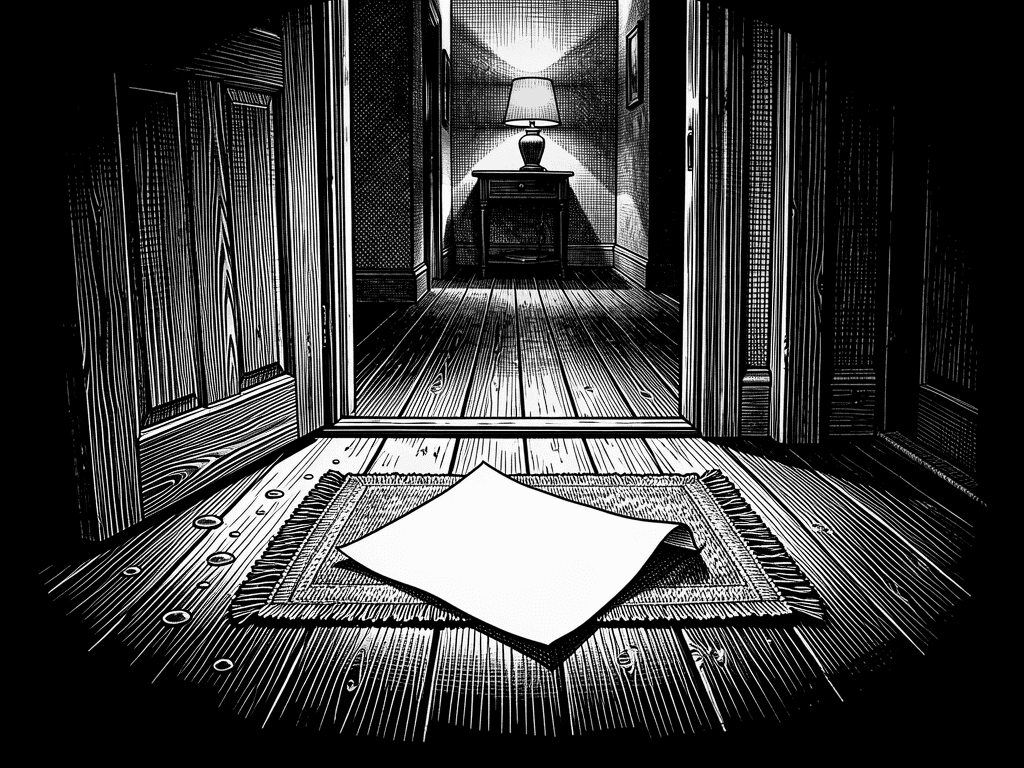
The letter is on the mat inside your door.
Not outside. Inside, on the little rag rug where you leave your shoes, as though it had been slid under the door and then had walked a polite distance in.
You pick it up. Cream paper, heavy, the kind that costs money, folded once and sealed with nothing at all — the flap simply tucked. Your name is on the front in ink that has the confidence of an older hand. June. Just that. No surname. No address, no street, no unit number. And — you turn it over twice, slowly, the way you'd check your pockets for keys you know you had a moment ago — no stamp. No postmark. No carrier's smudge, no barcode sprayed on in orange by the sorting machine. Nothing that says it came from anywhere. It is simply here, and it is dry, though everything you own is wet.
You stand in your coat and open it.
Dear June,
Forgive the intrusion of a letter. I find I am not comfortable with the newer ways of speaking to people — the little bright screens, the ringing. A letter waits. A letter is patient, and I am, if nothing else, patient.
I wanted, first of all, to thank you. You have kept the place warm, and I am grateful for it. Not everyone does. There have been years when the rooms stood empty through the whole long wet season, and the damp gets into the plaster, and the wood forgets the shape of being lived in. You have not let that happen. Every night you are at the window with your cup, and every night the lamp is on, and the whole top of the house glows a little from the road. I have noticed. It is a kindness, whether or not you meant it as one.
You will have felt, perhaps, that the winters here go on rather long. They do. They went on rather long before there was a "here" to name them after — before the hill had houses, before the road, when the water came all the way up to where your kitchen is now and the light off it at dusk was the only light for a very great distance. I mention this only so you understand that I am not new to the weather. I have kept many a season here. I know how the rain comes at the glass after dark.
I hope you will not think me forward if I ask after the little writing-desk — the one with the water-ring on the left corner, near the leg that is a touch shorter than the others, so it rocks when you lean on it. The oak one. Your oldest thing, I believe. I am fond of it. I trust it is keeping well. Do go on using it; a desk that is not written at is only firewood that has forgotten its purpose.
There is nothing you need do. I write only to open a correspondence between us, tenant to tenant, so that when the time comes to discuss the particulars of the arrangement, we will already be on friendly terms. I am in no hurry. I have never once, in all of it, been in a hurry.
Warmly, and with real fondness,
The Tenant
You read it standing. Then you read it sitting, at the desk, because your legs have decided to sit — the oak desk, your grandmother's desk, hauled up three flights of these stairs, the water-ring on the left corner that you have set your cup on ten thousand times, the short leg that rocks. You did not know anyone else knew about the leg. You had never told anyone about the leg. It is not the kind of thing you say out loud. It is barely the kind of thing you think.
The letter mentions it the way you'd mention a mutual friend. "I am fond of it. I trust it is keeping well." Too obvious to explain. The way you don't explain the rain.
You put the letter down and it lies there being ordinary, cream and heavy and real, and that is the worst part, that it is so completely real. You can smell the ink. You could carry it downstairs right now and show it to someone and they would agree that it was paper.
The kettle has boiled itself into silence in the kitchen. You go and make the tea because your hands want a thing to do that they already know how to do, and you carry the mug to the window, last thing, the way you do every night, and it is only when you are standing there with the steam on your face that you understand what you have just done. You have stood at the lit window. In the dark. With the whole top of the house glowing a little from the road.
"Every night you are at the window with your cup."
You do not, for the first time in years, want to look out. The glass has gone black with the evening and the rain is on it, and past your own reflection — your face, the lamp, the room behind you — there is the yard, and the wet road going down the hill, and the dark that used to be water. You look anyway, because not looking would be admitting something. You look, and there is nothing. Of course there is nothing. There is the rain coming sideways off the sea the way it has since before any of this had a name, and your face hanging in the glass looking back, and behind you, very faint, the sound of the house settling into the cold.
The radiator knocks. Once. Then, after a pause that lasts exactly long enough for you to notice it is a pause, it knocks again — twice, the way it always does, the way it has done every night you have lived here, just before it begins, at last, to warm.
Danny calls on Sundays. It is not Sunday. You think of calling him anyway, and you don't, because what would you say — someone left me a very polite letter and it knew about the desk — and because he never visits, he only calls, and a voice on the line three hundred miles away is not what you want tonight. What you want is for the room behind your reflection to stay empty.
It stays empty.
You leave the lamp on when you go to bed. You tell yourself it is so you can find your way. You know that is not the reason. The reason is on the desk, cream and patient, signed in that confident old hand, and it is in no hurry at all.